

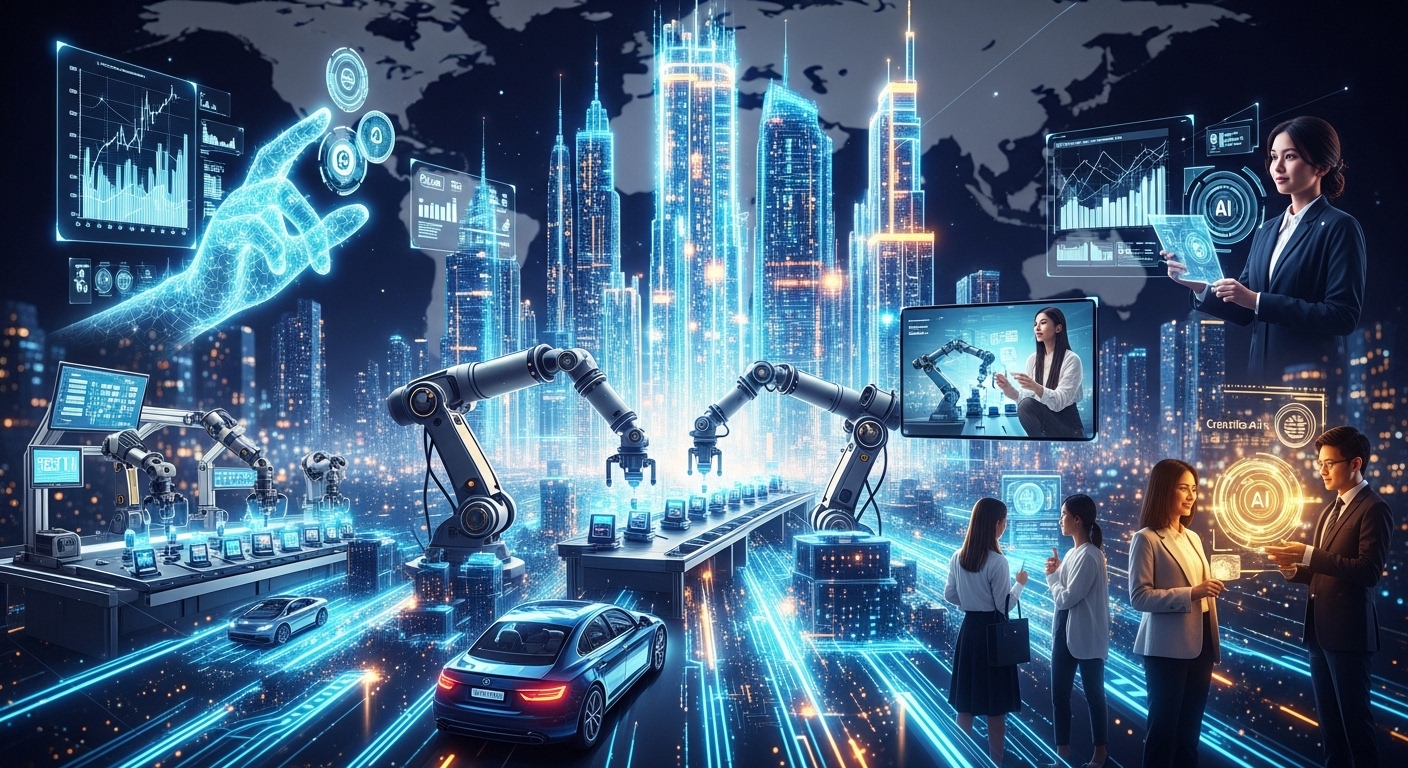
Artificial intelligence innovations are rapidly reshaping the future of the digital economy as businesses, governments, and consumers increasingly rely on intelligent systems for decision-making, automation, and value creation. From e-commerce and finance to logistics and creative industries, AI is redefining productivity, efficiency, and global competitiveness in the modern digital era.
AI Driven Digital Economy Transformation
Automated Business Operations
AI is transforming business operations by automating repetitive tasks such as data entry, customer support, and inventory management. This allows companies to reduce operational costs while improving speed, accuracy, and overall productivity across digital platforms.
Intelligent Decision Systems
Organizations are using AI-powered decision systems to analyze large datasets and generate insights. These systems help businesses make faster and more accurate strategic decisions, improving competitiveness in global markets.
Digital Service Optimization
AI is enhancing digital services by improving personalization, recommendation engines, and user experience design. Companies are leveraging these capabilities to deliver more relevant and efficient services to customers worldwide.
Workflow Efficiency Enhancement
Artificial intelligence is streamlining workflows across industries by integrating smart automation tools. This improves coordination between departments and reduces delays in business processes.
Predictive Business Modeling
Predictive AI models are helping companies forecast demand, consumer behavior, and market trends. This enables better planning, risk management, and resource allocation in the digital economy.
AI Impact on Global Financial Systems
Algorithmic Trading Expansion
AI-powered algorithmic trading systems are reshaping financial markets by executing trades based on real-time data analysis, improving speed and accuracy in investment decisions.
Fraud Detection Improvements
Financial institutions are using AI to detect fraudulent transactions by identifying unusual patterns and behaviors, strengthening security in digital payment systems.
Credit Risk Assessment
AI models are improving credit scoring systems by analyzing alternative data sources, enabling more accurate risk assessments for loans and financial services.
Automated Banking Services
Banks are increasingly adopting AI-powered chatbots and virtual assistants to handle customer inquiries, account management, and financial guidance.
Financial Forecast Accuracy
AI-driven forecasting tools are enhancing economic predictions, helping institutions better understand market fluctuations and financial risks.
E-Commerce and Retail Revolution
Personalized Shopping Experiences
AI is transforming e-commerce by offering personalized product recommendations based on user behavior, preferences, and purchase history.
Smart Inventory Management
Retailers are using AI to optimize inventory levels, reduce waste, and ensure product availability based on predictive demand analysis.
Customer Behavior Analysis
AI tools analyze customer interactions to understand buying patterns, enabling businesses to design more effective marketing strategies.
Automated Pricing Systems
Dynamic pricing systems powered by AI adjust product prices in real time based on demand, competition, and market conditions.
Virtual Shopping Assistants
AI-powered assistants guide customers through online shopping experiences, improving engagement and conversion rates.
AI in Logistics and Supply Chains
Route Optimization Systems
AI is improving logistics by optimizing delivery routes, reducing fuel consumption, and improving delivery times across global supply chains.
Demand Forecasting Models
Supply chain systems use AI to predict demand fluctuations, ensuring better planning and reduced operational inefficiencies.
Warehouse Automation Growth
AI-driven robotics are automating warehouse operations, improving speed, accuracy, and inventory handling efficiency.
Real Time Tracking Systems
Advanced tracking technologies powered by AI provide real-time visibility of shipments across global logistics networks.
Supply Chain Risk Management
AI helps identify potential disruptions in supply chains and provides early warnings to minimize operational risks.
AI Transformation of Labor Markets
Job Role Evolution
AI is changing job roles by automating repetitive tasks and increasing demand for analytical, technical, and creative skills.
Remote Work Optimization
AI tools support remote work by improving collaboration, communication, and productivity tracking across distributed teams.
Skill Based Employment Shift
The digital economy is increasingly favoring skill-based hiring, especially in AI, data science, and digital marketing fields.
Workforce Productivity Tools
AI-powered tools enhance employee productivity by automating routine tasks and providing intelligent assistance in decision-making.
Human AI Collaboration
The future workforce is moving toward collaboration between humans and AI systems to maximize efficiency and innovation.
AI and Digital Innovation Ecosystem
Startup Innovation Growth
AI is fueling startup growth by lowering barriers to entry and enabling rapid development of digital products and services.
Platform Economy Expansion
Digital platforms powered by AI are expanding, connecting users, businesses, and services in more efficient ecosystems.
API Driven Development
AI-based APIs are enabling developers to integrate intelligent features into applications quickly and easily.
Open Source AI Progress
Open-source AI tools are accelerating innovation by allowing global collaboration and shared technological advancement.
Cloud AI Integration
Cloud platforms are integrating AI services, making advanced tools accessible to businesses of all sizes.
Ethical and Economic Challenges
Data Privacy Concerns
The increasing use of AI raises concerns about how personal data is collected, stored, and used across digital systems.
Algorithm Bias Risks
AI systems can reflect biases in training data, leading to fairness and ethical challenges in decision-making.
Job Displacement Issues
Automation may replace certain jobs, requiring workforce reskilling and adaptation to new digital roles.
Regulatory Uncertainty
Governments are still developing frameworks to regulate AI use, creating uncertainty for global businesses.
Cybersecurity Threats
AI systems can be targeted by cyberattacks, requiring stronger digital security measures and monitoring.
Future of AI Driven Digital Economy
Fully Automated Industries
Many industries will become highly automated, with AI managing operations, logistics, and customer interactions.
Hyper Personalized Services
Digital services will become increasingly personalized, adapting in real time to user needs and behavior.
Global AI Integration
AI will be deeply integrated into global economic systems, influencing trade, finance, and communication.
Smart Economic Systems
Future economies will rely on intelligent systems to manage resources, predict trends, and optimize growth.
Continuous Innovation Cycle
AI will create a continuous cycle of innovation, driving long-term transformation of the global digital economy.
FAQs
How is AI changing the digital economy?
It improves automation, efficiency, and decision-making across industries.
What industries benefit most from AI?
Finance, retail, logistics, healthcare, and technology benefit greatly.
Does AI affect jobs?
Yes, it automates some jobs while creating new skill-based roles.
What is the role of AI in e-commerce?
It enables personalization, pricing optimization, and customer analysis.
What is the future of AI in the economy?
It will create fully intelligent, automated, and connected systems.
Conclusion
AI innovations are fundamentally reshaping the future of the digital economy by transforming industries, enhancing productivity, and enabling smarter decision-making. As adoption continues to expand globally, AI will drive new economic models and opportunities. Despite challenges such as ethics and regulation, the long-term outlook remains highly transformative, positioning AI as a core pillar of future digital growth worldwide.